
This post may contain affiliate links. Please read our disclosure policy.
Make your own chickpea tempeh at home with just 3 ingredients and basic equipment! This soy-free tempeh ferments into a firm, sliceable cake with a mild mushroomy taste and zero bitterness. Use it in stir-fries, soups, sandwiches, and more!
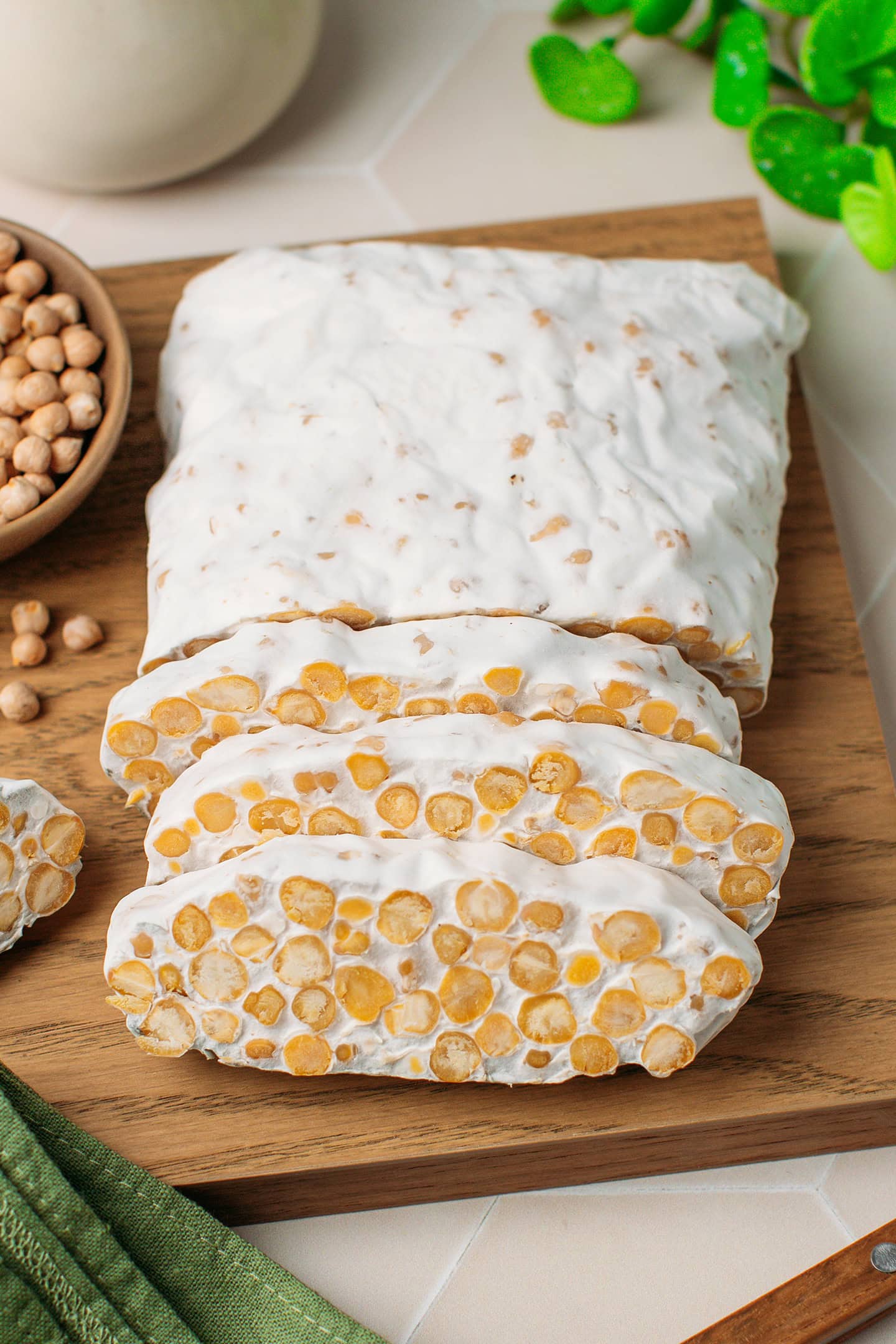
Tempeh is one of those recipes that looks intimidating until you make it. And then you wonder why you waited so long! My method requires just 3 ingredients and creates a compact loaf of tempeh with even mold growth. It holds together well, can be sliced, and has absolutely no bitterness.
This tempeh doesn’t rely on traditional soybeans. Instead, it uses chickpeas, making it entirely soy-free! I’m also sharing different methods for incubating it, so it works with standard kitchen equipment. Ready to dive into the (moldy) world of tempeh?
Looking for more tempeh recipes? Check out my black bean tempeh, okara tempeh, or regular soybean tempeh!
📘 What’s Chickpea Tempeh?
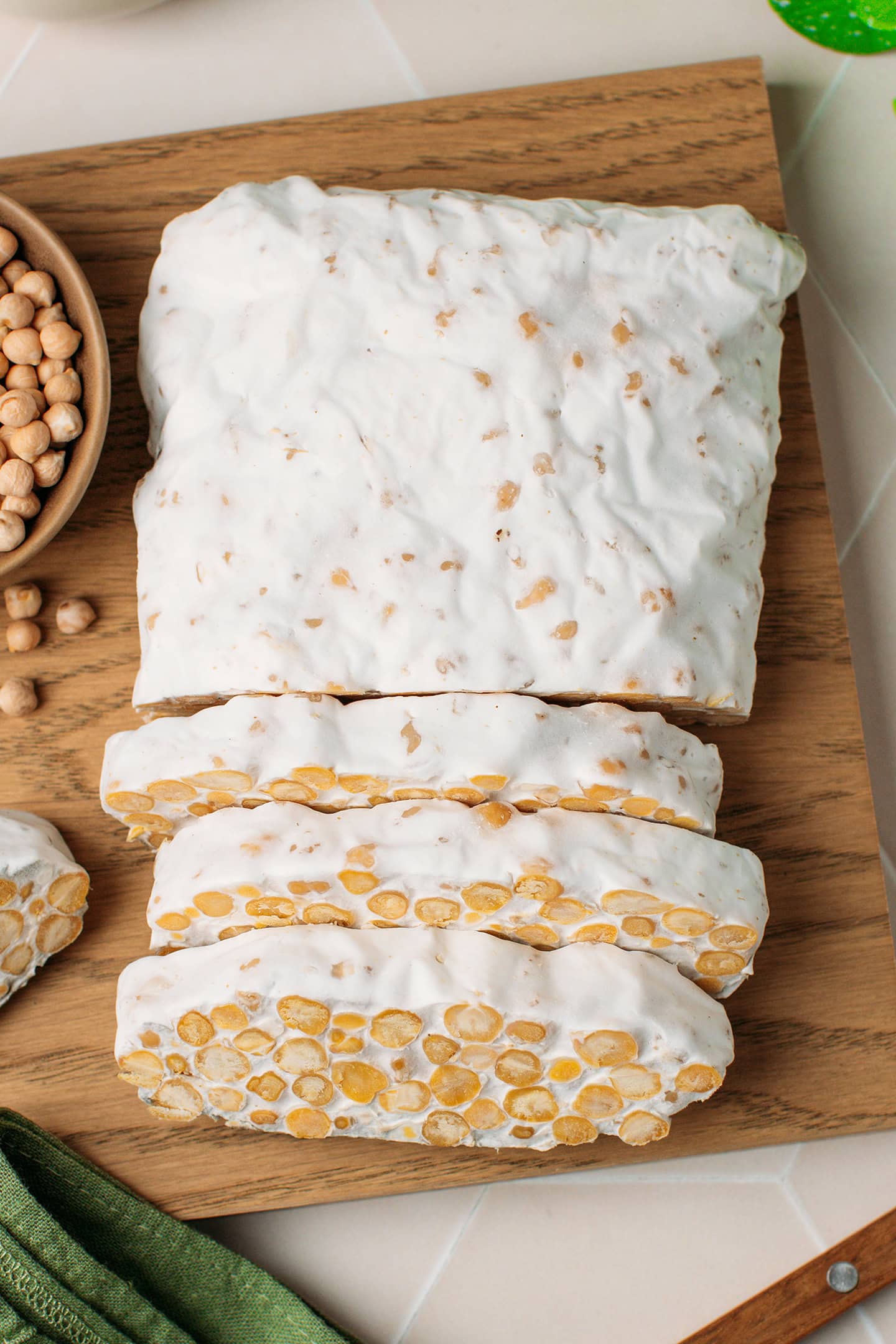
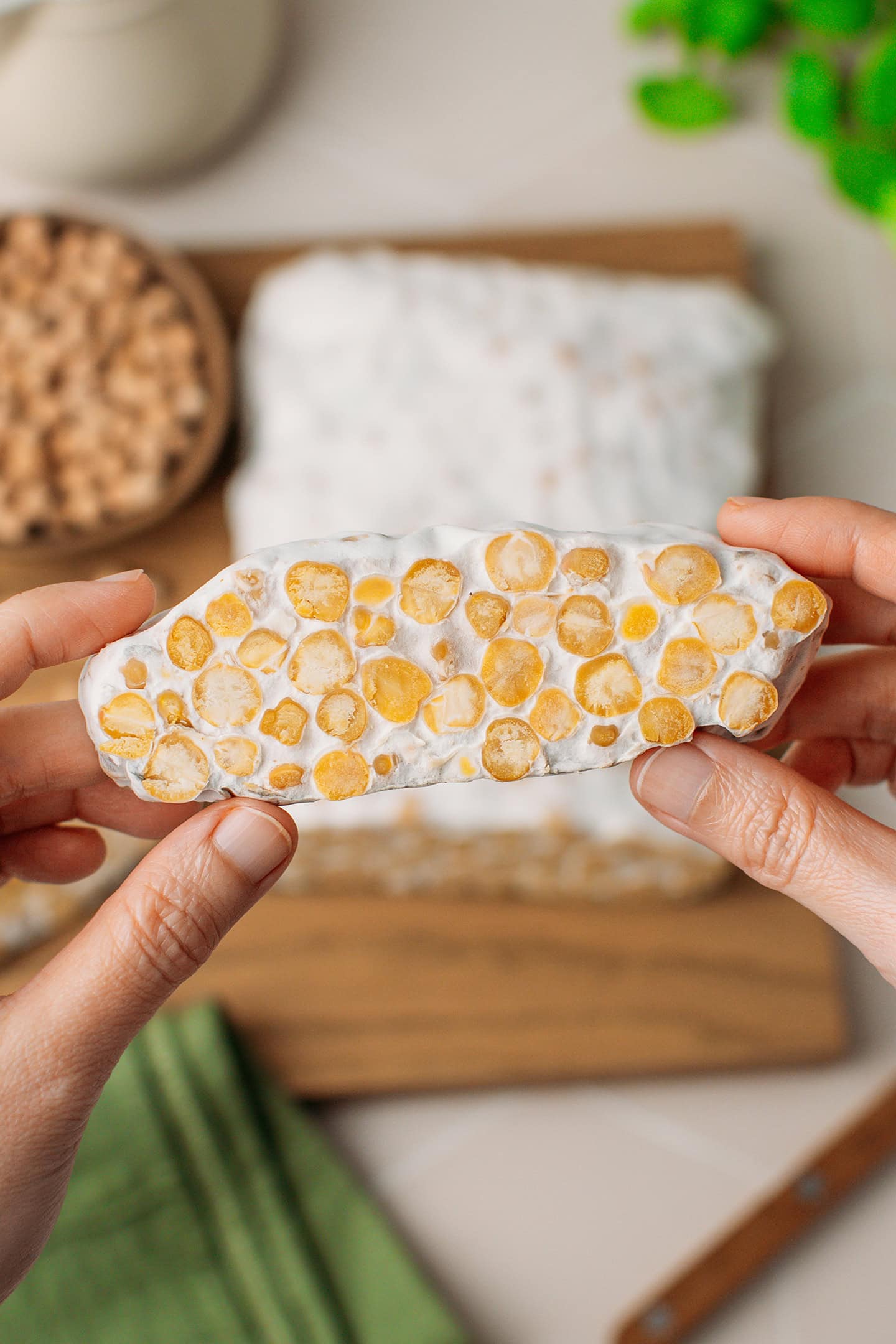
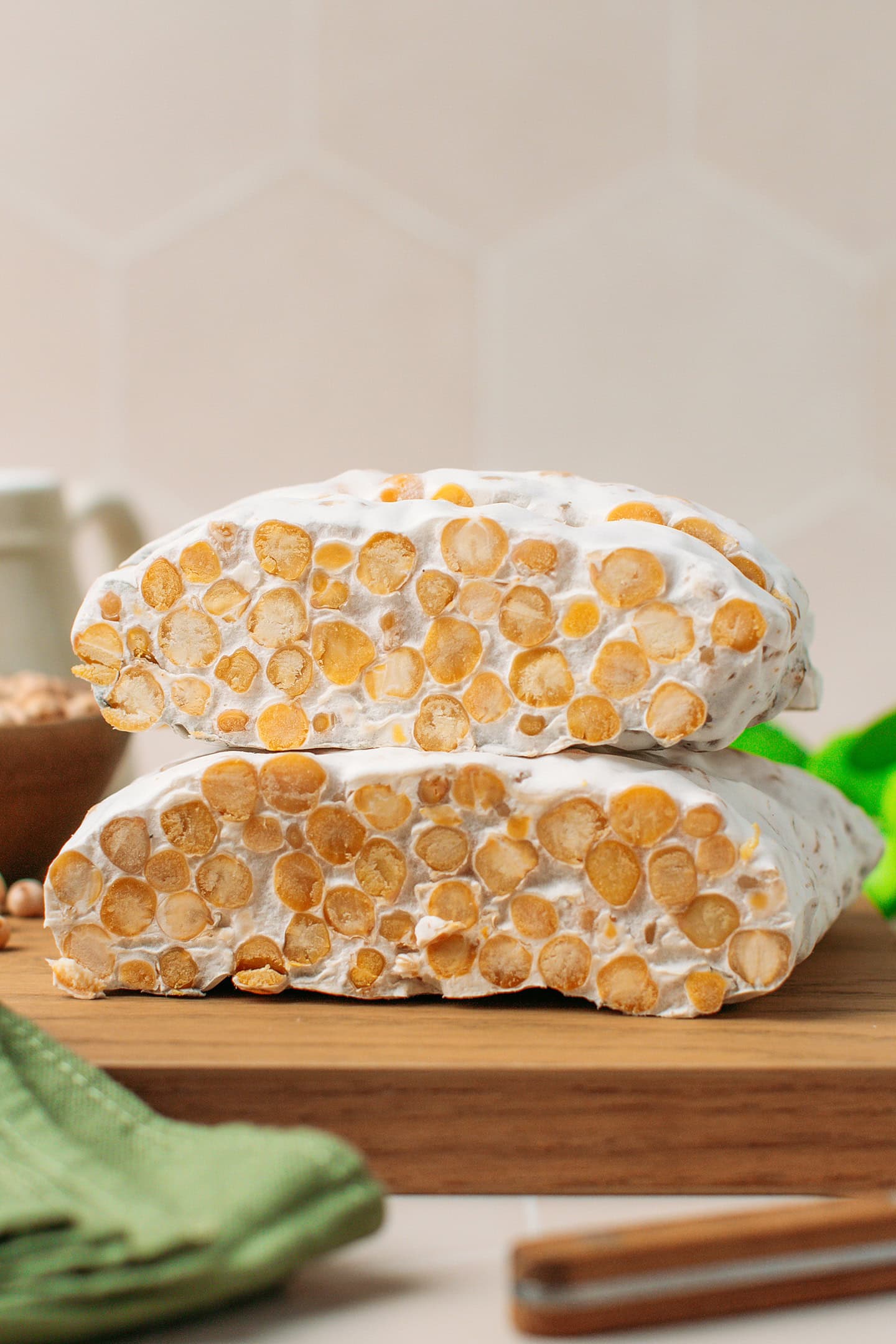
Chickpea tempeh is a variant of the traditional Indonesian soybean tempeh. It is made by cooking chickpeas and fermenting them with a mold called Rhizopus Oryzae for about 48 hours. Once fermentation is complete, the chickpeas are bound together into a compact cake by a white mold. It then becomes sliceable and ready to cook.
🌿 Ingredients You Need
Here are the three ingredients you will need to make it:
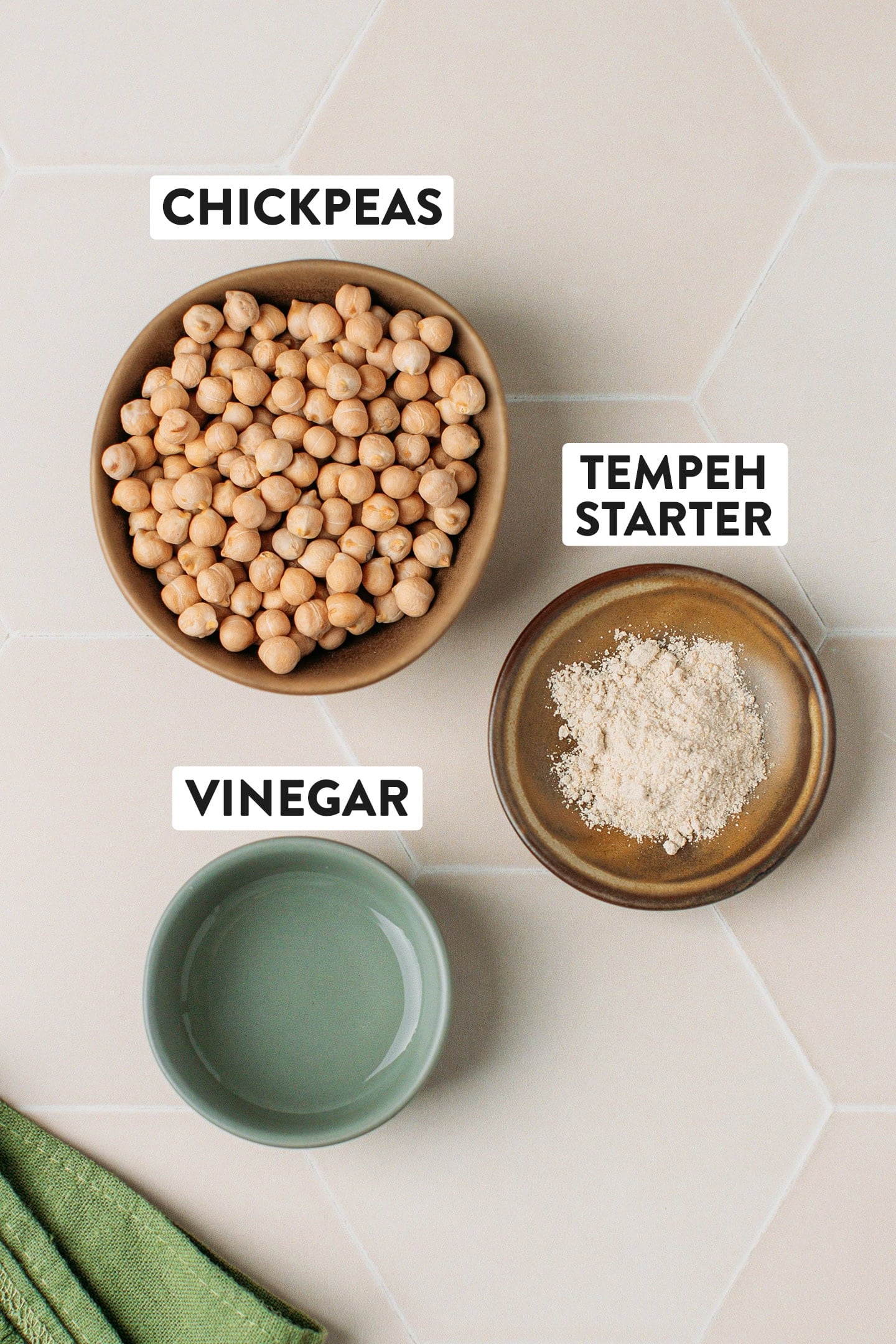
- Dry chickpeas – For the best results, use small dry chickpeas, not garbanzo beans. Because garbanzo beans are bigger, there is more space between each bean. This makes it harder for the mold to bind them into a compact loaf. It works, but it will take longer for your tempeh to ferment, and it won’t be as compact.
- White vinegar – Vinegar helps prevent the growth of potentially harmful mold or bacteria. I suggest using white vinegar, but apple cider vinegar also works.
- Tempeh starter – Tempeh starter contains Rhizopus oligosporus spores, which initiate fermentation and bind the chickpeas into a firm cake.
Note: Not all brands of starter are soy-free, as some may contain soybean flour.
🔅 Fermentation Equipment: Which Method Works Best?
Oven with light on: Turn on the oven light only. The oven temperature should reach approximately 85-90°F (30-35°C) for the best results.
If your oven does not allow you to turn on the light without turning on the heat, set it to the lowest temperature (with the fan off), then turn it off before placing the tempeh inside. You will have to repeat this step if your oven temperature goes under 85°F (30°C).
Dehydrator: Similar to the oven method, set your dehydrator to 85-90°F (30-35°C) to incubate the tempeh.
Instant Pot/Yogurt maker: My pick! Use the Instant Pot on Yogurt mode (set to “Normal”) or a standard yogurt maker. From my experience, the “Normal” setting works better than “Less”, especially during winter.
Note: Fermentation time may vary depending on the method and ambient temperature. I suggest checking after 24-32 hours and letting it ferment more if needed.
🥣 How to Make It (Step-by-Step)
1. Soak the Chickpeas
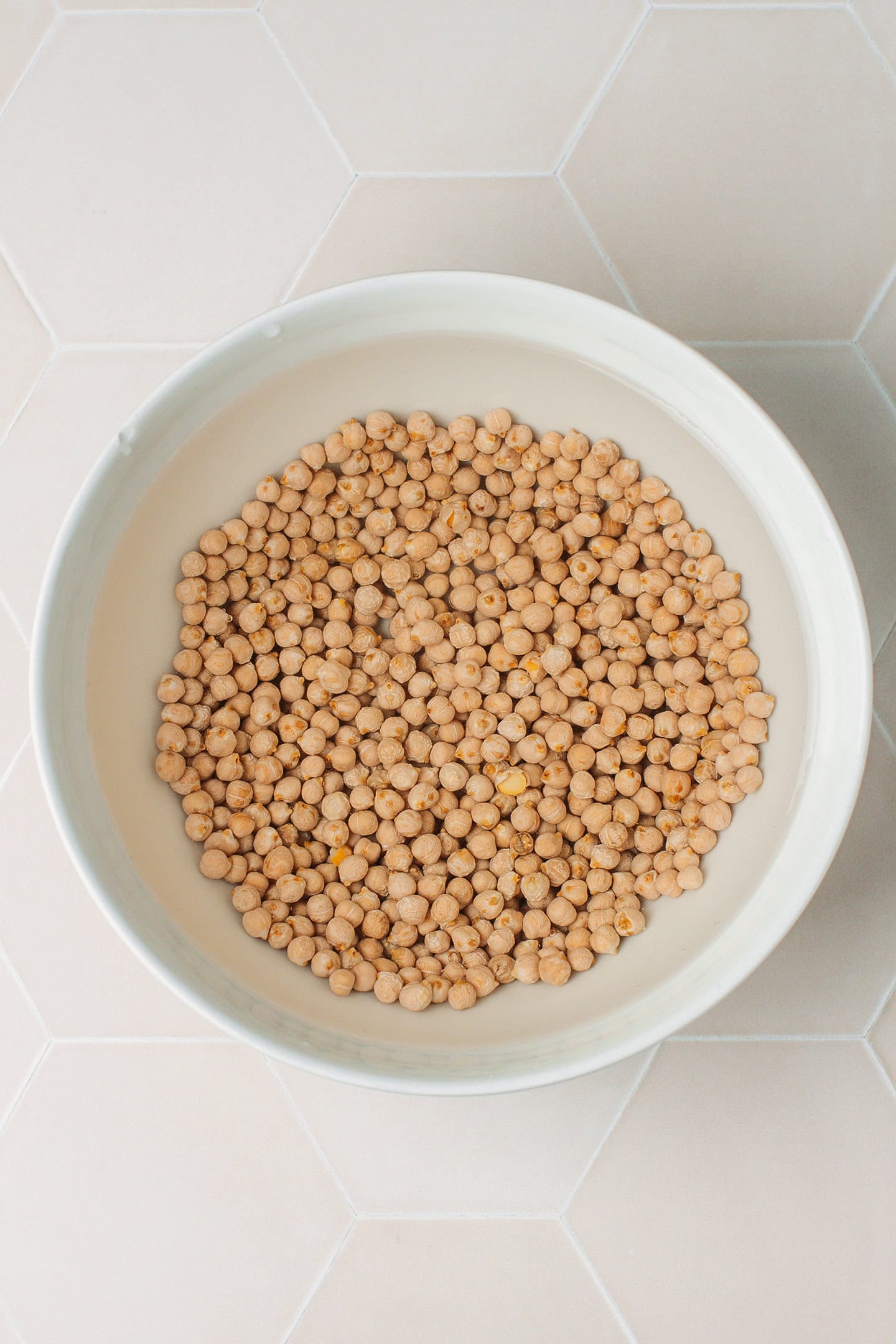
- Soak the chickpeas. Add the dry chickpeas to a bowl and cover with water.
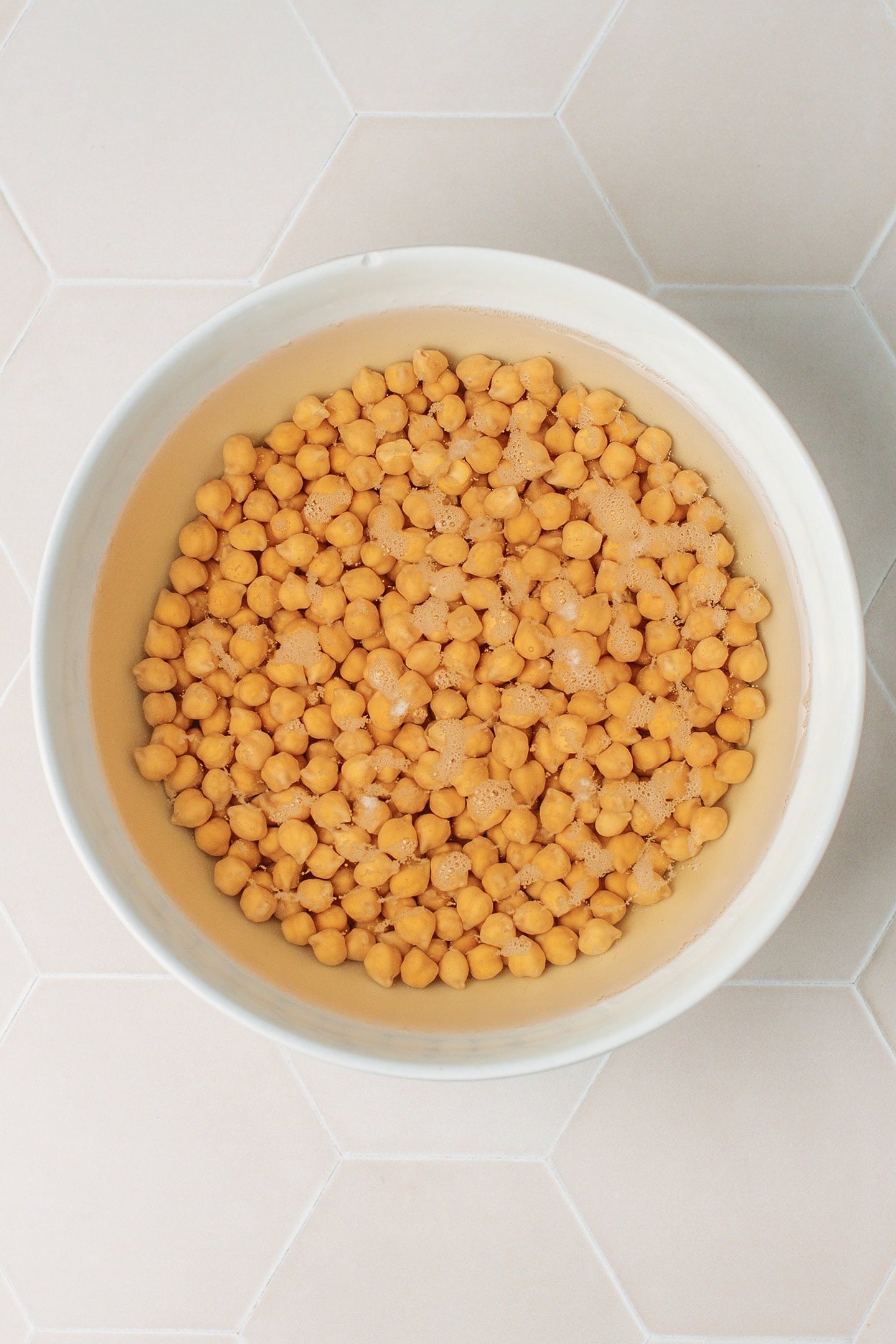
- Let them soak overnight. The next day, drain them.
2. Cook them
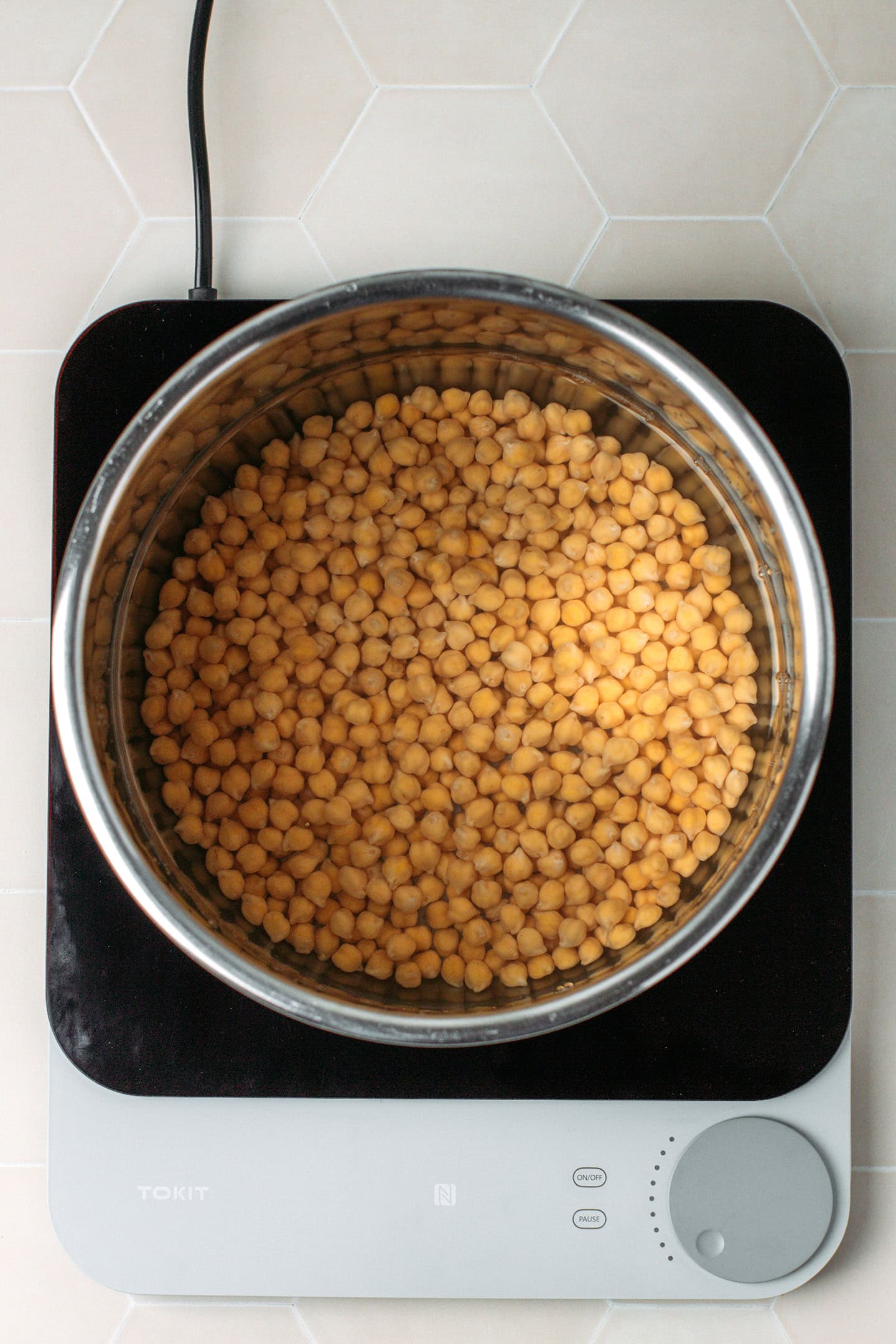
- Transfer to a pot. Transfer the chickpeas to a large pot and cover with water.
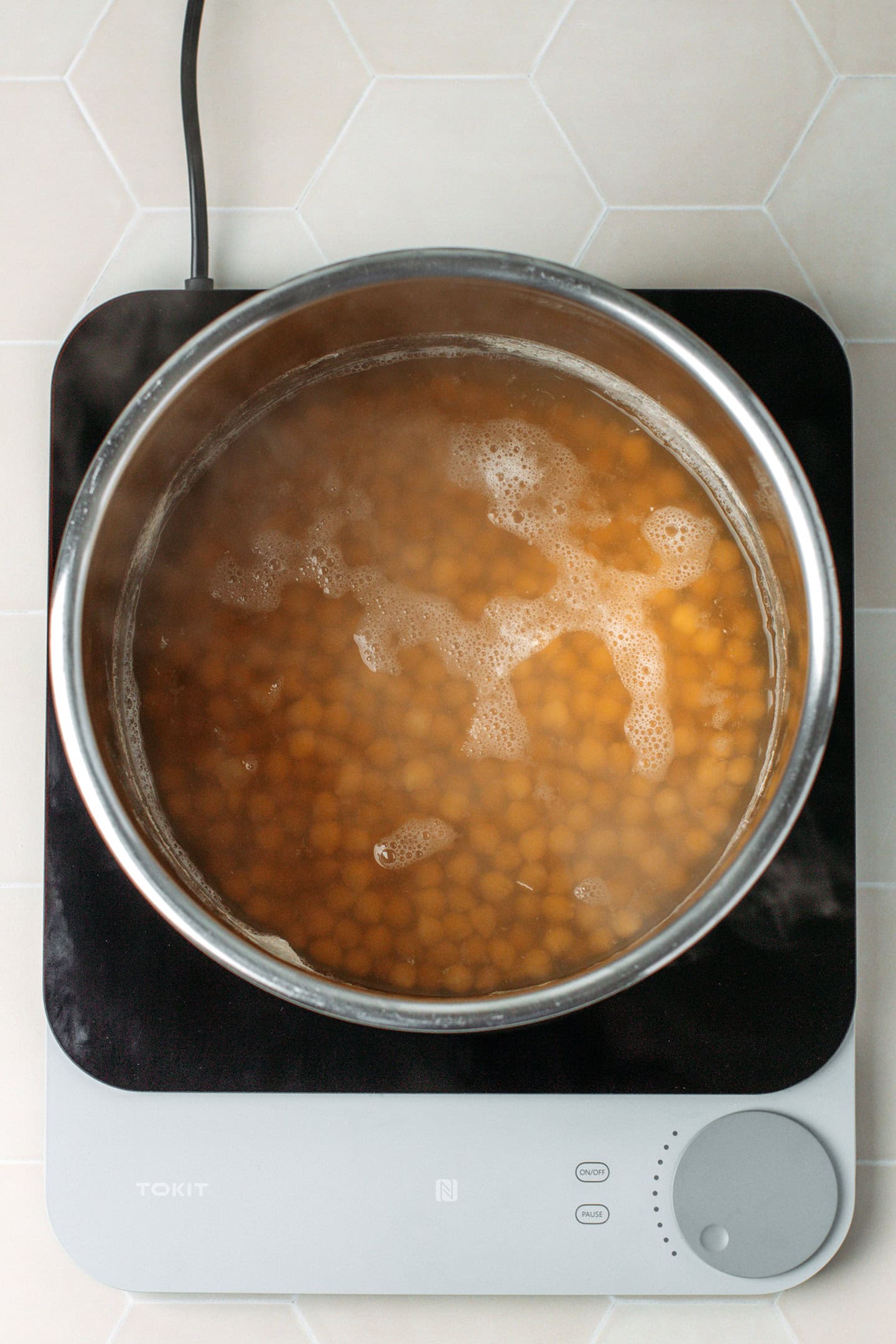
- Simmer. Bring to a boil, then simmer for about 60 minutes or until the chickpeas are tender.
3. Prepare the loaf
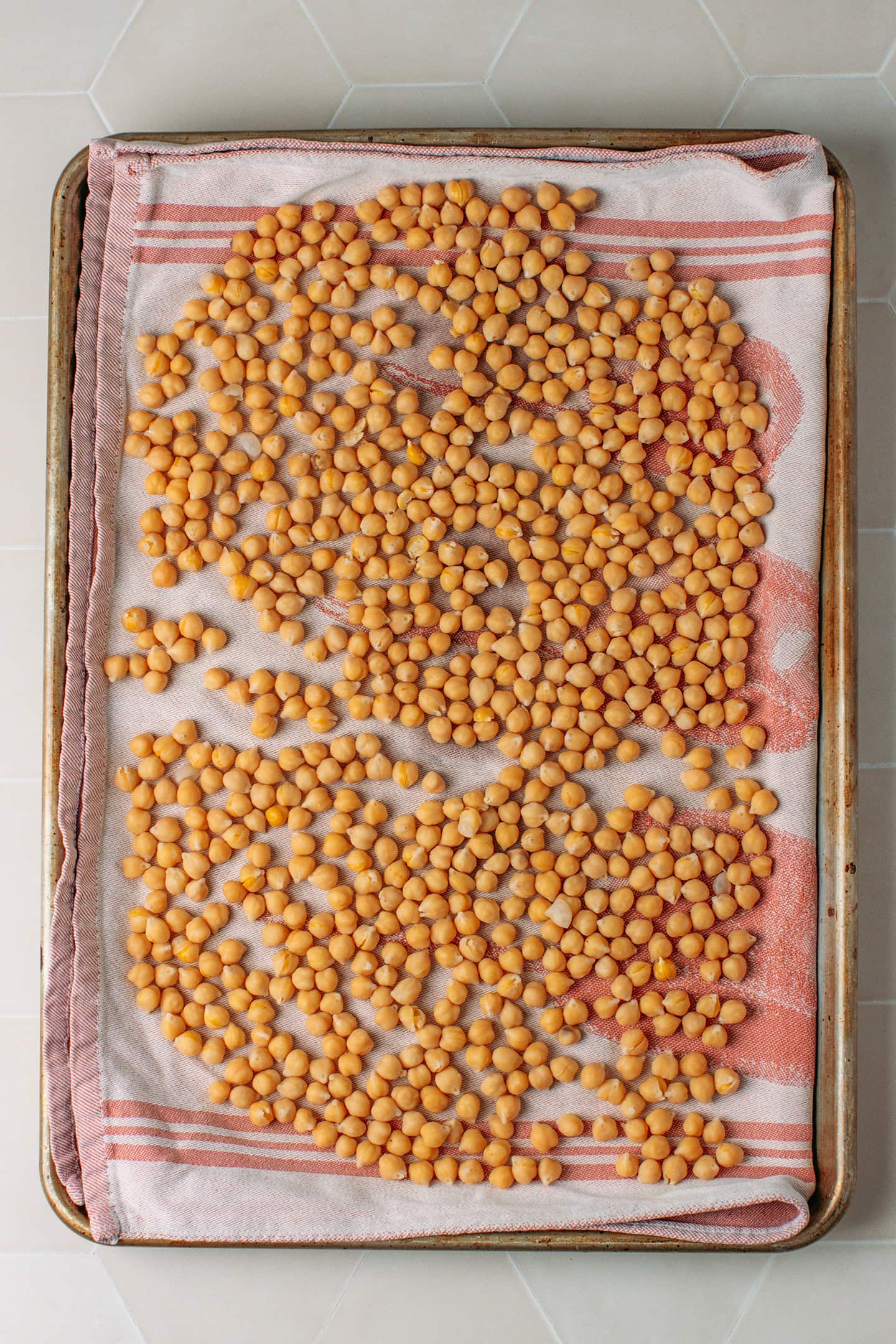
- Drain. Drain the chickpeas well. Then, spread them on a baking sheet lined with a clean kitchen towel. Dry for 20 minutes.
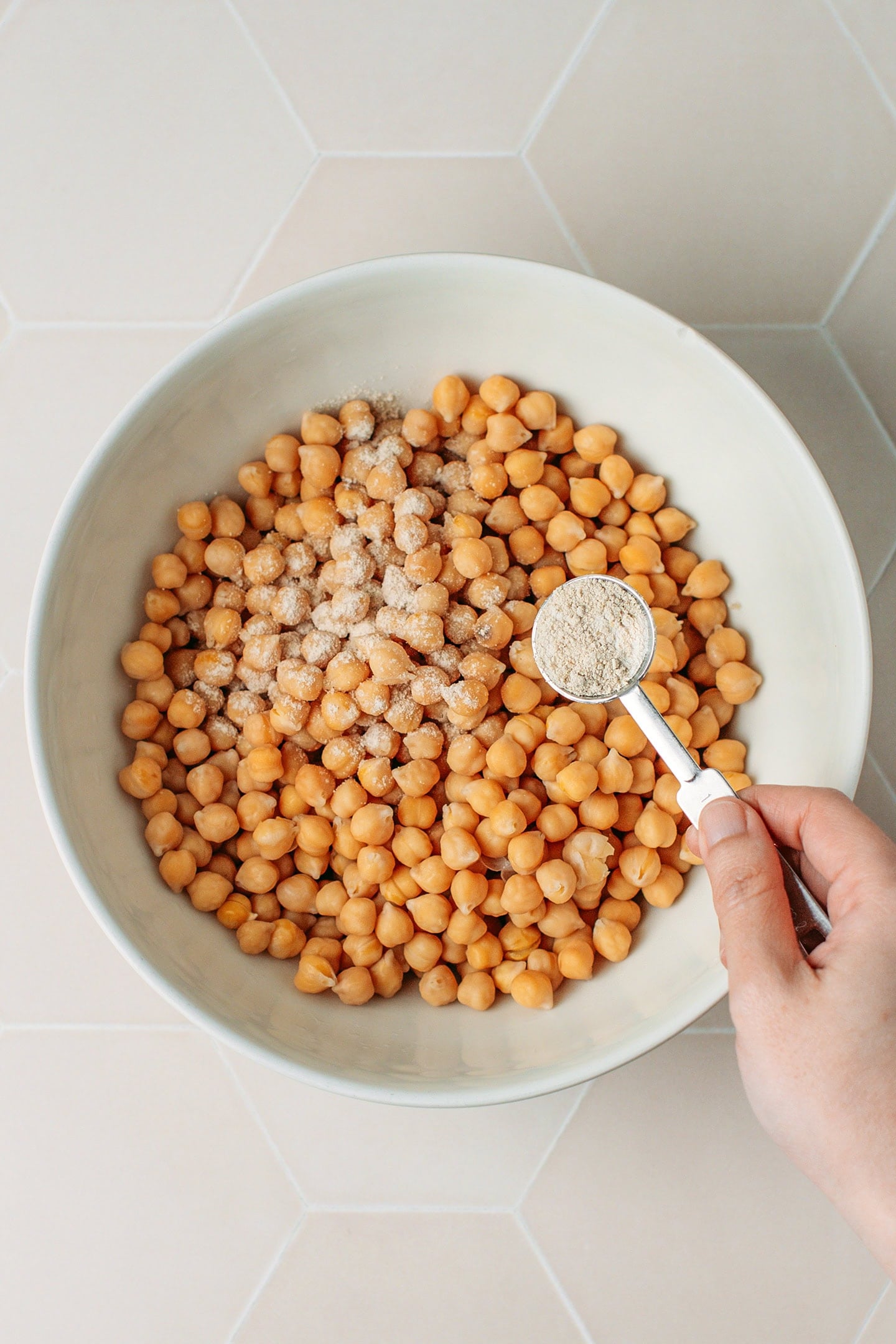
- Mix. Transfer the chickpeas to a large mixing bowl. Add the vinegar and stir to combine. Then, add the tempeh starter and stir to coat.
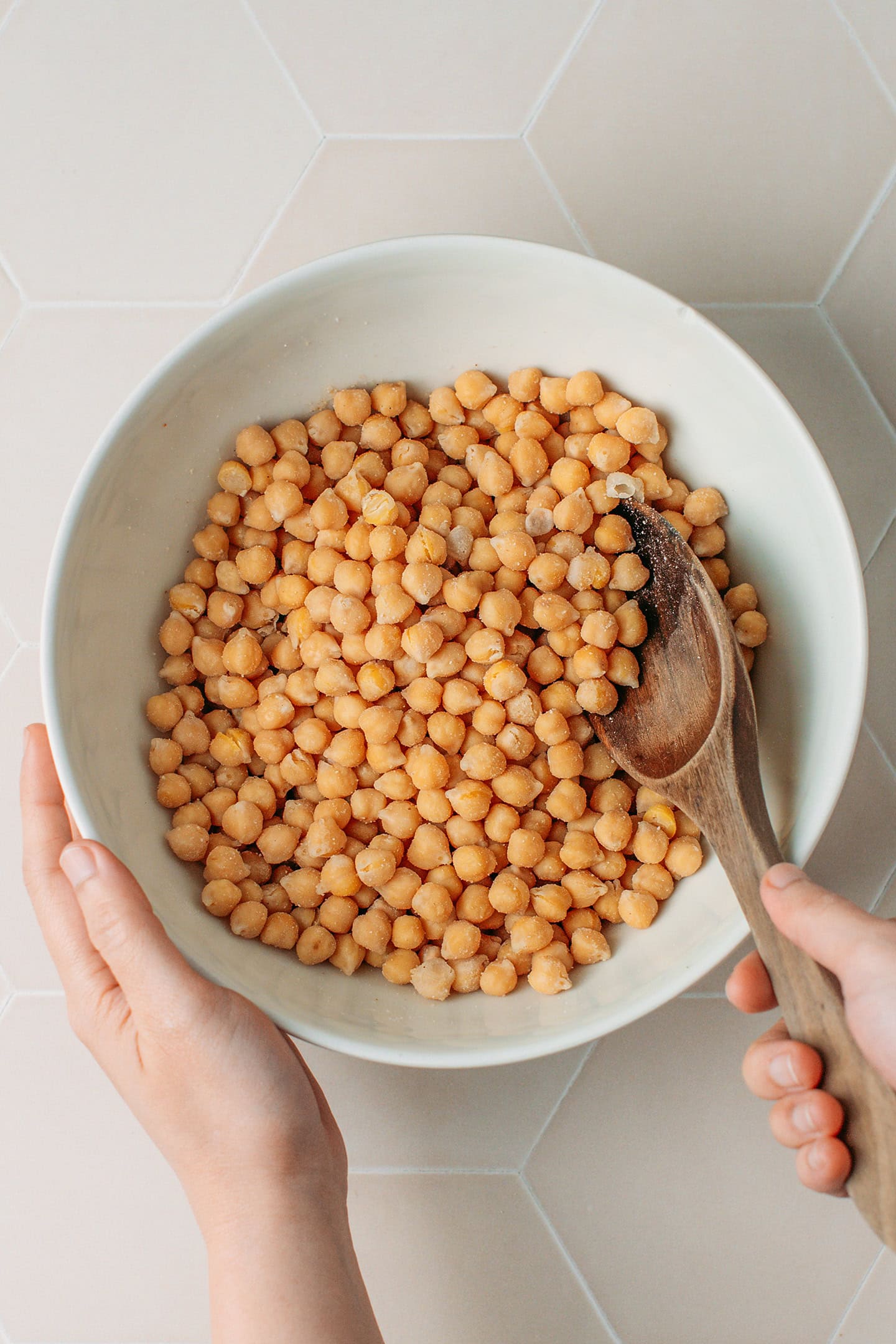
- Mix well to ensure the chickpeas are evenly tossed with the starter.
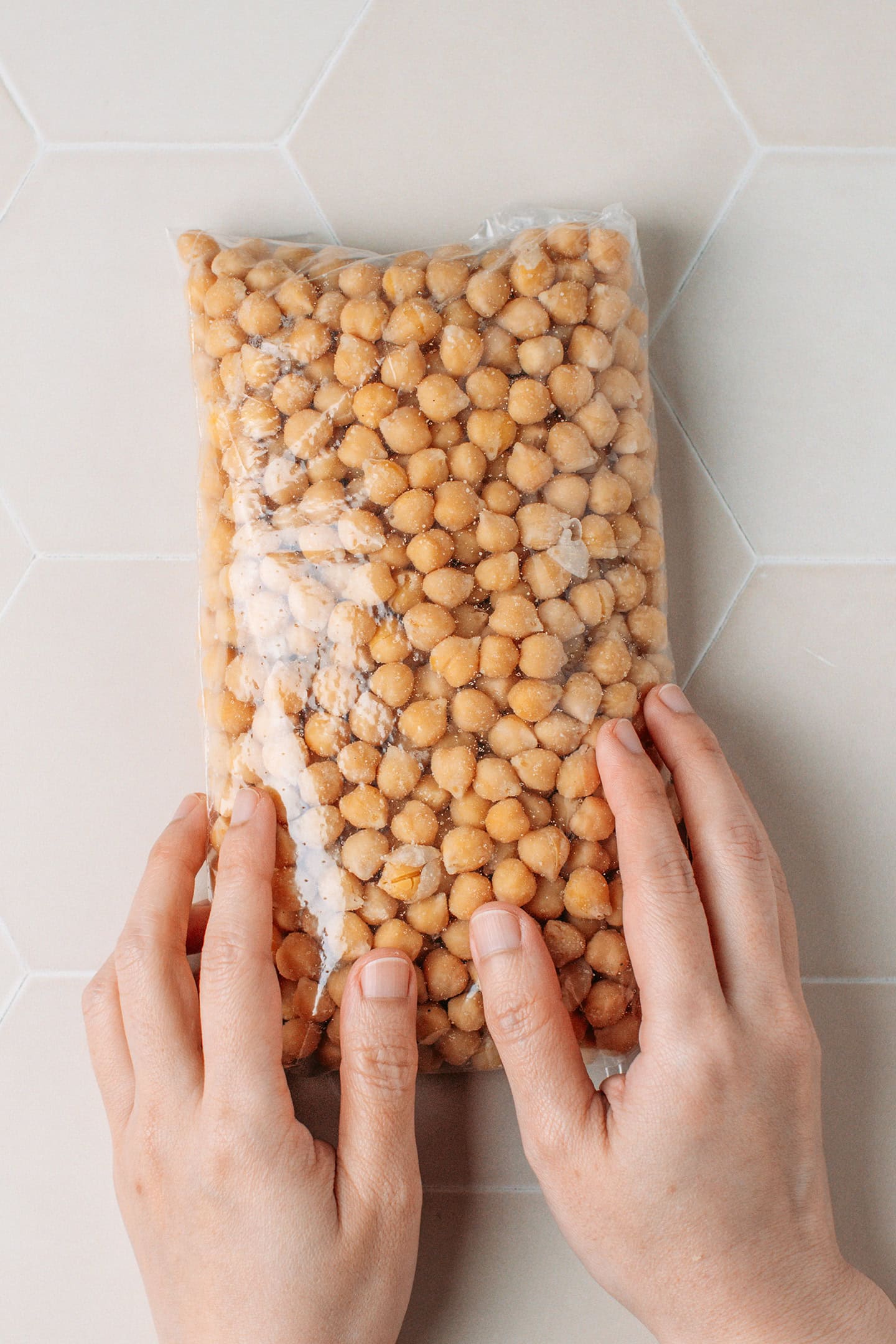
- Transfer to a bag. Transfer the chickpeas to a freezer bag and shape them into a long loaf about 1 and 1/3 inches (3.5 cm) thick.
4. Incubate
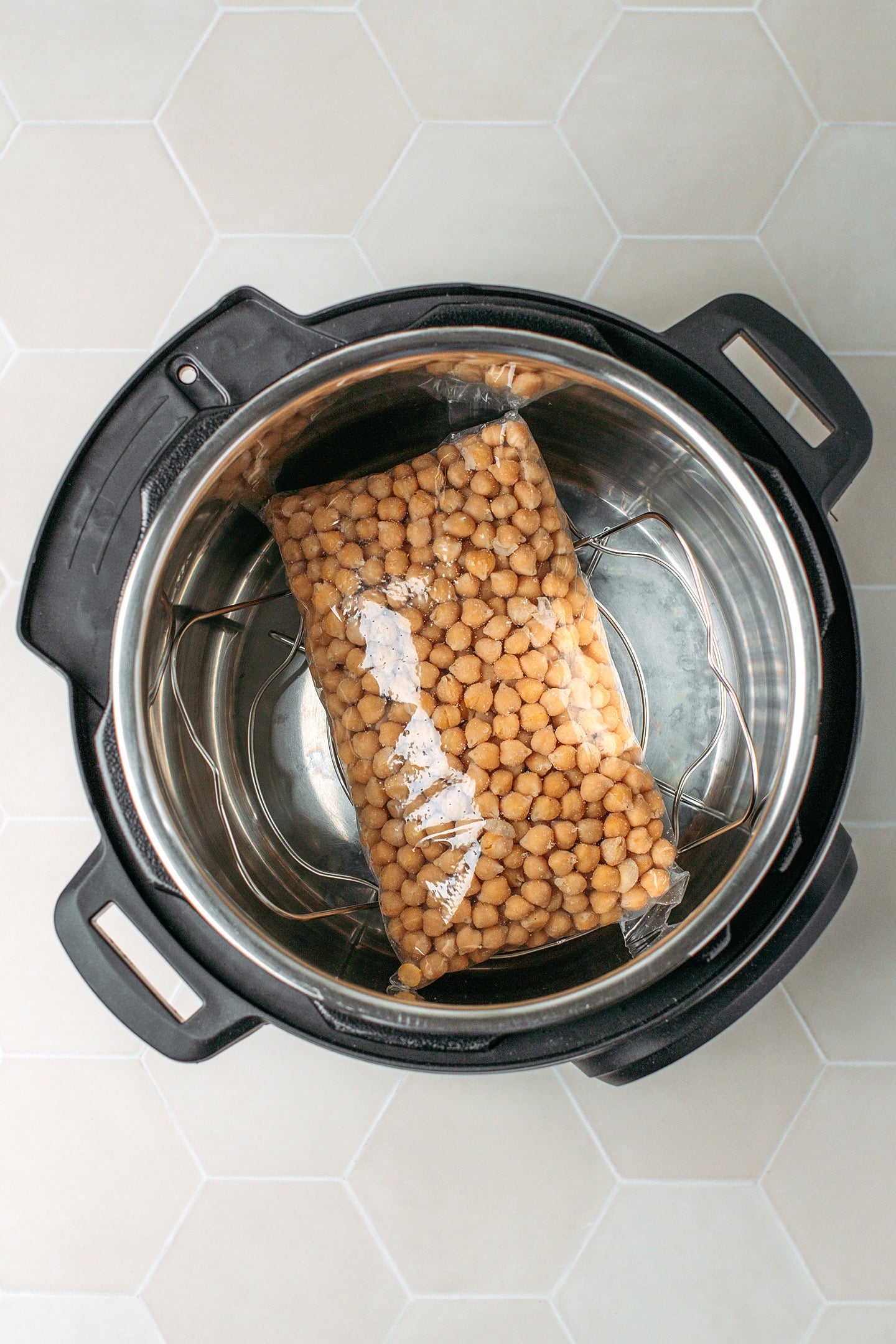
- Transfer to the Instant Pot. Place the bag on a rack inside the Instant Pot or Yogurt maker.
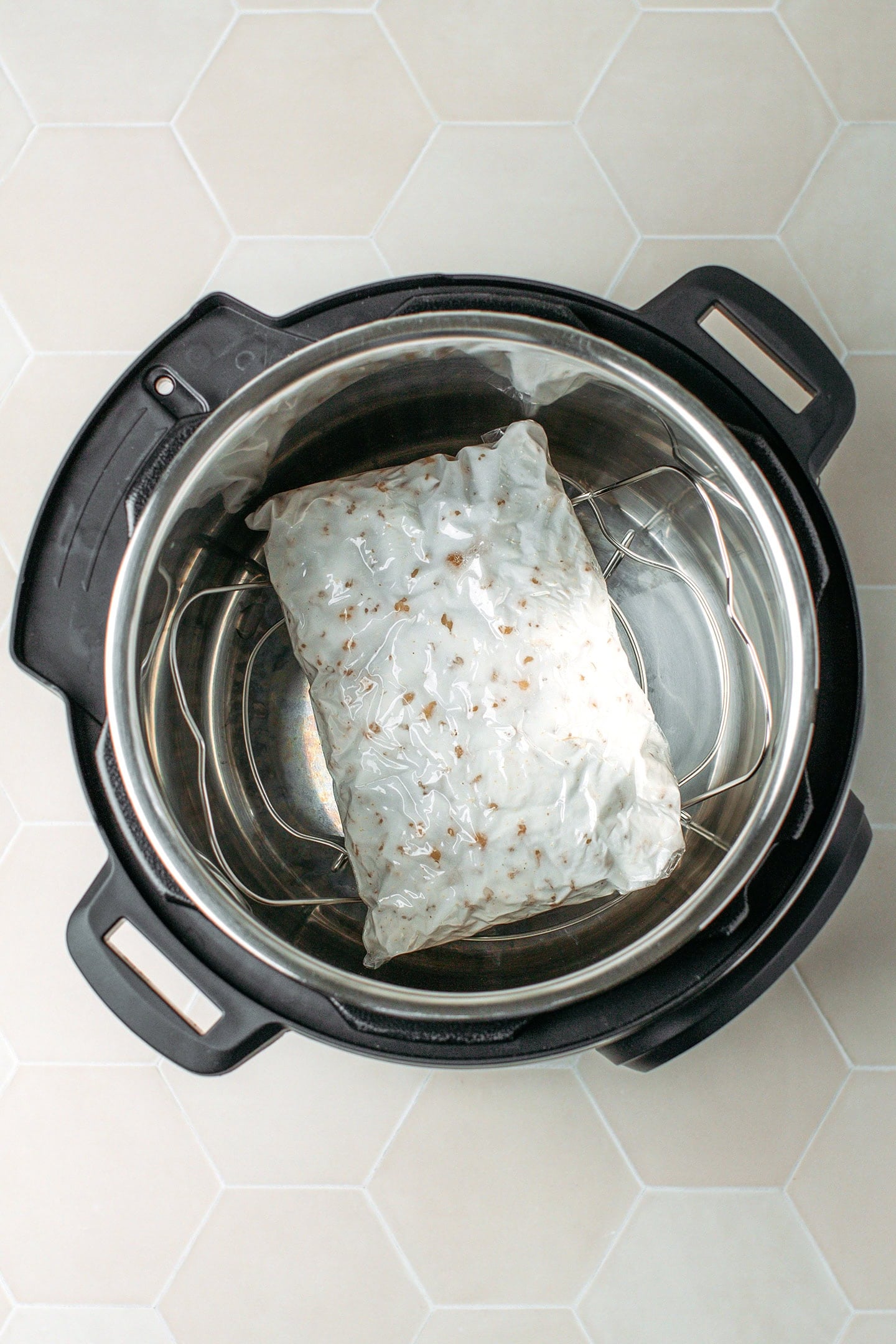
- Incubate. Close with the lid and set the Instant Pot to yogurt mode for 32 hours.
⏱️ How Do You Know When Tempeh Is Ready?
After about 32 hours, your tempeh loaf should be 80% covered with white mold. At this point, you can turn off the Instant Pot, yogurt maker, or oven and let it ferment for another 6-8 hours.
Not sure if your tempeh is done? Here are two ways to tell:
- Do you still see the chickpeas? Your tempeh should appear completely white with little to no visible chickpeas. If you can still see many chickpeas through the bag, it needs more time to ferment.
- Is it compact and holding together? Hold the tempeh in your hands. It should feel firm and hold together as a compact loaf. If it seems a bit crumbly or bends easily, it’s not ready yet.
📔 Tips
Cook the chickpeas until tender, but not overcooked.
The chickpeas must be fully cooked for two reasons. First, the mold won’t grow properly on undercooked beans. And second, uncooked chickpeas will remain tough and unpleasant to eat, even after fermentation.
Dry the chickpeas well.
For optimal mold growth, the chickpeas must not be too moist. Do not skip this step – spread them on a clean kitchen towel and let them dry for 20-25 minutes.
Pack them tightly.
Transfer the chickpeas to a perforated freezer bag and pack them tightly, without mashing them. If there’s too much space between chickpeas, mold may not grow properly, preventing them from binding into a firm block.
🌯 How To Cook Tempeh
Just like tofu or soy tempeh! Here are a few ideas:
- Marinate: Marinating tempeh slices is the best way to add flavor. One of my favorite marinades consists of one part sesame oil, one part maple syrup, two parts soy sauce, chopped garlic, and your favorite herbs or spices (I like five-spice powder). Marinate for at least 2 hours before baking or shallow-frying.
- Bake: Marinated or plain tempeh can be baked for about 20 minutes at 350°F (175°C). The longer you bake it, the firmer and drier it will get.
- Fry: Tempeh fries beautifully. It becomes crispy on the outside and remains soft on the inside. Frying obviously adds some calories, but makes very tasty tempeh.
Not sure where to start? Check out my Dan Dan noodles with tempeh scramble, tempeh in creamy mushroom coconut sauce, or these sesame and peanut tempeh skewers!
Note: If you want a milder taste, you can first steam it for 20 minutes before using it in recipes. This is not mandatory, though.
❄️ Storing and Freezing
- To store: You can store this chickpea tempeh for up to one week in the refrigerator.
- To freeze: Wrap in plastic wrap or transfer to a freezer-safe bag and freeze for up to 6 months. Thaw overnight in the refrigerator.
💬 FAQs & Troubleshooting
No. That’s the advantage of making chickpea tempeh: no peeling is needed!
Tempeh fails to form a firm cake when mold growth is insufficient. This typically happens for one of the two reasons:
1. Insufficient fermentation time: The mold didn’t have enough time to grow, and there is empty space between chickpeas. The tempeh needs more time.
2. Inadequate temperature: The fermentation environment is too cool, slowing down, or not even starting mold growth. Ensure the temperature is 85-90°F (30-35°C).
Depending on the temperature and thickness of your tempeh, it will take between 32 and 48 hours.
Yes, but expect different results. Large garbanzo beans leave more space between beans, making it harder for the mold to fully bind them together. The finished tempeh will be less compact and will crumble more easily when sliced.
You do not have to steam it. Steaming tempeh is often recommended if it has a bitter flavor, but I’ve never had any bitterness with homemade tempeh.





Save this recipe!
Enter your email below and I’ll send it to your inbox!
Plus, you will receive new recipes every week!
How To Make Chickpea Tempeh (Soy-Free)
Ingredients
- 1 cup (210 g) dry small chickpeas
- 1 tbsp (15 ml) white vinegar I used white rice vinegar
- 1 tsp tempeh starter
Instructions
- Soak the chickpeas. Place the dry chickpeas in a large bowl and cover with water. They should be fully submerged. Let them soak overnight.
- Drain them. The next day, drain and rinse the chickpeas under cold water.
- Cook them. Transfer the drained chickpeas to a large cooking pot. Cover with water (it should be about 2 inches (5 cm) higher than the chickpeas). Bring to a boil, then let simmer for 1 hour. Depending on the size of your chickpeas, it might take up to 1 and 1/2 hours. Chickpeas must be soft but not completely mushy.
- Drain them. Once the chickpeas are tender, drain them and leave them in the strainer for 30 minutes. After that, spread them on a baking sheet lined with a clean kitchen towel. Let the chickpeas drain and dry for 20-25 minutes.
- Inoculate with the starter. Transfer the chickpeas to a large mixing bowl. Add the white vinegar, and stir until all the chickpeas are "coated" with the vinegar. Sprinkle the tempeh starter over the beans and mix until well combined.
- Prick a freezer bag. Use a metal skewer or a fork, prick holes in a small freezer bag (I used a 7×8-inch bag) at about 1-inch (2.5 cm) intervals. This step is important for creating good air circulation and allowing the mold to grow.
- Fill the bag. Transfer the chickpeas to the freezer bag, then shape them into a loaf measuring about 5×8 inches, and about 1 and 1/3 inches (3.5 cm) thick. Then fold the remaining bag over the chickpeas to keep them tight.
- Incubate. Three ways to incubate the tempeh:Instant Pot: Arrange a rack inside the Instant Pot liner. Place the bag of chickpeas on it and close the Instant Pot lid. Set the Instant Pot mode to "Yogurt" ("Normal" mode) and set the timer to 32 hours.Yogurt maker: Place the bag of chickpeas inside your yogurt maker and set the timer to 32 hours.Oven: Turn on the oven light (don't turn on the heat). The oven temperature should reach approximately 85-90°F (30-35°C) for the best results. Place the tempeh inside the oven for 30-32 hours.
- After about 32 hours, you should see a thin layer of mold covering the chickpeas. At this point, you can turn off the Instant Pot, yogurt maker, or oven and let it ferment for another 6-8 hours. The tempeh will generate its own heat.
- Your tempeh is ready when it is fully covered with white mold and forms a solid cake, which usually happens at the 48-hour mark. It can be quicker if the temperature in your house is high.
- Raw tempeh will keep for up to a week in the refrigerator.
Notes
Cook the chickpeas until tender, but not overcooked.
The chickpeas must be fully cooked for two reasons. First, the mold won’t grow properly on undercooked beans. And second, uncooked chickpeas will remain tough and unpleasant to eat, even after fermentation.Dry the chickpeas well.
For optimal mold growth, the chickpeas must not be too moist. Do not skip this step – spread them on a clean kitchen towel and let them dry for 20-25 minutes.Pack them tightly.
Transfer the chickpeas to a perforated freezer bag and pack them tightly, without mashing them. If there’s too much space between chickpeas, mold may not grow properly, preventing them from binding into a firm block.Nutrition

About the Author
Thomas Pagot is the founder, photographer, and recipe developer behind Full of Plants. He created the blog in 2016 as a personal cookbook for vegan recipes. Through years of recipe development, Thomas has successfully grown Full of Plants into a trusted resource for plant-based recipes.
Leave a Comment
Have you ever used canned chick peas? If so, what were the results?
I have never tried using canned chickpeas, sorry!
Hi, do you de-hull the chickpeas? From what I read usually for other beans we need to dehull them before the fermentation. I’ve never cooked chickpeas so I’m not sure whether they have hull 😂
Hi Helen,
I didn’t de-hull the chickpeas, and it worked great!
I just made this recipe — the tempeh turned out a more grey than white. Is it still safe to eat?
Tempeh should be very light grey to white. If it’s really grey, I doubt it’s safe to eat.
Why can’t you just cook the chickpeas completely in the Instant Pot, like the soybeans, why do you have to soak them first? Also, why not crush them down, so there is less room between them?
You could, however it will take longer to cook.
Well, traditionally, tempeh HAS room between each bean, allowing the mold to grow and helping the beans hold together. You can slightly crush them, but you still need enough air holes inside to let the mold grow.
You are so wonderful! Can I use Garbanzo recipe in the instant pot too like your instant pot recipe
for soybean tempeh? Heard about you through Plant Pure Chef Our adorable best cook, KIM Campbell
Definitely! The incubation process is the same 🙂
Can you use your instant pot method withc chickpeas?
Yes!
Thank you for your great recipes. Can I use your instant pot recipe and substitute the soy beans with chickpeas or other legumes?
You’re welcome Jane!
Sure!
One of my favorite
ChickPea Tempeh is also great for making feta chess
Follow up comment, my tempeh didn’t have any bad smell but, was dark gray all over with large white spots, what is wrong? the temperature was 85-89 like I said before.
It’s very hard to say, try using perfectly clean tools/bag next time, and if it still happens maybe your starter has a problem.
Hi, chickpeas were very dry, , and turn hard, I add the vinegar and mixed
And the tempeh starter and mixed, I did every thing according. I used my oven with the pilot only,
The temperature was 87 -89
Thank you
Hi Mary, what do you mean “turn hard”, you should only let them “dry” for 30-40 minutes.
Hi Thomas, I tried this recipe twice, but it grew gray mold and it smelled really bad. Until I saw here in the comments, that it was possible to put it to ferment on banana leaves. I tried, and this time it worked. I am very happy for this, as I am using my oven for this. Thank you so much for your recipes.
Glad to hear you had success with your second try! Maybe your plastic bags had a problem.
After a bit of a performance I finally got this to work. I managed to kill my first try, as I blindly went for the “put it on the oven with the light on” part. Unfortunately, actual room temperature was already perfect for incubating the Tempeh (end of summer here… My kitchen is a happy 28 – 30 °C, and the oven, just with the light on, was reaching 35, which basically zapped the starter.
SOOO, I added another 1/4 teaspoon of starter to the mix, made more holes in the bag and 30 hours later (and with a lovely meat thermometer happily spiked well into the bag) I can now say that I have made my first block of Chickpea Tempeh.
This is the first of what I hope will be many many many that I make. And I am so excited to try other variations and more recipes.
Amazing site!
Awesome! So glad to hear you had success with it!
i made black chick peas tempe . mycellium is formed but the tempe is breaking. is it safe to consume ? there is no bad smell
I guess you didn’t let it incubate enough so there is not enough white mold to hold everything together. It’s still good to eat.
Hi. Thomas! I’m wondering if you’ve tried making this chickpea tempeh in an Instant Pot before, and if so, how the instructions would change for making it in an Instant Pot? I tried making this chickpea tempeh myself following your instructions for making black bean tempeh in an Instant Pot(just using chickpeas in place of the black beans) and my chickpea tempeh didn’t grow enough mold, etc. Would chickpeas need to be cooked longer in yogurt mode, or do chickpeas require a longer period of time in a pressure cooker after the yogurt mode time is complete?
Another question I have is: If I want to double a batch of black bean or chickpea tempeh (or any other variety, really), would I use double the amount of water called for in the Instant Pot directions for making black bean tempeh, or would I still just add one cup of water to the bottom of the Instant Pot?
Hi Holly,
I did, I always use my Instant Pot to make tempeh no matter if it’s with chickpeas, soybeans, or black beans. Yes you should follow my Instant Pot Tempeh recipe, regarding the incubation time it really depends and I found out it can vary. Take a look from time to time, once a good amount of mold has appeared you can usually turn the Instant Pot off as the tempeh generates its own heat.
If double, use the same amount of water. Just be aware that I didn’t always had great results by stacking tempeh loaves in the IP.
Thanks, Thomas. This really helps!
Hi. Should we end up with holes all over (and both sides) of the bags of tempeh, or should we only be puncturing the bag only in a single row, with holes spaced about an inch apart?
Hi Holly,
You should end up with holes on both sides of the bags.
Can the chickpeas be pureed to make the tempeh? I would prefer a more creamier tempeh and wondered if this can be made with pureed chickpeas?
I would not recommend it, if using mashed beans the mold might have trouble growing. It needs air to grow.
I used to eat tempeh, and even made my own from soybeans.
One day I ate too much fried tempeh (well-fried tempeh is absolutely delicious and reminds me of bacon) and got sick and couldn’t eat again. I believe this has a lot to do with the fat-content of soybeans, which is unusually high.
Then a day ago I had an idea why not try chickpeas, and now it seems its a common enough thing. You site came up first on Google, so there you go.
I probably won’t use tempeh culture starter, just grind up commercial (live) tempeh very fine and dry it out.
you saud dont ovwrcook tge beans till mushy. juat curious what happens if you cook the beans to much and they are mushy or really broken up? how does this impact the tempah? thank you
That is correct, you don’t want the beans to be too mushy. I have never tried with overcooked beans so I cannot say.
Too mushy and the beans will mush together, even with holes poked through. The air won’t get through and you’ll get both tempeh-mold and other molds. It risks just getting a rotten mess that will have to be thrown out.
Good to know!
Love the taste, better than soy beans . Thank you for sharing!!
You’re welcome Rifa!
I’m excited to try to make chickpea tempeh. I plan to use this recipe instant pot style. Hope it turns out well
Would it work to sprout the beans prior to cooking?
This is a good question, I honestly have no idea.
How long would you recommend to cook the chickpeas in the instant pot?
I would recommend soaking overnight, and then pressure cook 5 minutes. Then let the pressure release naturally for another 20 minutes.
I made soybean tempeh successfully. I just tried making chickpea tempeh but only a bit of white mold formed and the rest of the beans turned gray/brown. It tastes funky. Should I try splitting the chickpeas in a blender before boiling them to create smaller more compact tempeh so that the mold spreads throughout?
Yes, that could be an idea. I haven’t tried but I think it should work!
I will be cooking garbanzo beans in Instant pot to help with lectin removal. Has anyone had expirience with how long to cook them?
Also is it OK to season prior to incubation? I was going to use onion granules, hickory salt & chipotle powder.
Is there a way to make this without plastic?
You may use banana leaves.
I have tried making tempeh twice now, but always have condensation forming even though I dry my beans well. Instead of throwing away the current batch, could I just add more vinegar and starter culture to the beans with new plastic bags and containers?
I’m afraid just adding more vinegar it won’t work…
Hi Thomas,
My chickpea tempeh turns out great, nicely packed and great mycelium growth but it has a very strong fermented taste that I find over powers any flavor i try to cook it with. Any suggestions? Ive read it could be to do with the vinegar and when this is added?
Thanks for your help.
Hi Brooke,
Have you tried to steam the tempeh for about 30 minutes?
Has anyone tried making lentil tempeh? On my 1st attempt now incubating french lentil, hemp seed & brown sesame seed tempeh in instant pot on yogurt less setting. I am nervous it won’t turn out.
Hi Thomas, I was thinking of making this in the instant pot (finally got one!!!). Do I just follow the soy instructions but replace with chickpeas? Also do you have to peel the chickpeas doesn’t seem to mention that you have to in this recipe.
Hi John, yes it will work with the instant pot recipe!
I usually don’t peel the chickpeas but if you prefer to do so, you can place them in a bowl of water and rub with your hands to remove most of the peels. Then drain on a clean kitchen towel.
This recipe sounds wonderful. I’ve never made anything like this before and our family is trying to reduce our use of plastic. Do you have any idea whether or not this could be made in a glass container? Thank you!!
Thanks Julia,
Humm…I’m not sure about the glass container honestly, I think the mold will stick to it and it will be difficult to remove the tempeh from the container. You may use banana leaves though.
do you mean use banana leaves inside a glass container?, we to are not into using plastic bags or plastic wrap
No I mean just place the beans in banana leaves and wrap it tightly, no need to use a glass container.
Hey
I have made it in a glass container and it was fine. Didn’t stick at all actually. I have limited to a max 1 inch high. Best results I had so far was covering with an aluminium foil with holes on it trying to keep it as tight as possible. I tried also covering with organic cotton cloth it was ok but less compact on the top because there was more air circulation vs aluminium foil.
Also tried doing it in cotton cloth(wrapping the whole thing) it was ok but not very compact compared to the above methods.
I want to try with silicone ziplock next
Why would the aluminium foil need to be really tight? (if there are holes in it, then the tightness serves no purpose).
The vinegar (and fermenting mold) risks attacking the aluminum and adding a mawkish off-taste of aluminum salts, which are also slightly toxic. The taste may not be noticed because tempeh’s own strong flavor, but you might not want to be consuming biologically active aluminum ions.
http://www.ncbi.nlm.nih.gov/pubmed/28752219